You have been told your pool needs to be replastered. Then you find out the old plaster has to come off first.
Now you are not just paying for a new pool finish. You may be paying thousands of dollars to remove and prepare the old surface before the new finish even goes on.
That may be exactly the right preparation if you are putting another plaster, quartz, pebble, glass-bead or polished cement-based finish back in the pool. But it does not necessarily mean another cementitious finish is your only option.
In some pools, EcoFinish can be installed without removing every inch of sound existing plaster. Hollow, loose, cracked, delaminated or otherwise unsound areas still have to be found and repaired. The remaining substrate has to be suitable and properly prepared. EcoFinish is not a shortcut for covering bad plaster—but when the sound substrate can stay, it can completely change the scope and economics of a resurfacing project.
“If I’ve got an older pool that’s already been plastered and I’m being told I’ve got to spend thousands of dollars just removing the old finish before I can put another cement-based finish back on it, that’s where EcoFinish starts making a whole lot of sense to me. If the plaster that’s there is sound enough to keep, we can repair what isn’t sound, prepare the pool correctly and put EcoFinish over the sound substrate. I don’t see a reason to tear good material out just so I can put another cement product back in.”
Why would a contractor tell me the old plaster has to come off?
Because sometimes it should. Multiple previous finish layers, delamination, hollow areas, deteriorated material and transitions around fittings can make another cementitious application a poor candidate for simply going over what is there. Matt may recommend extensive removal himself when the condition of the pool calls for it.
So if another plaster contractor tells you removal or Hydro-Prep is needed before another cement-based finish, that does not automatically mean you are being upsold. The better question is: does the pool have to receive another cement-based finish after that?
10 reasons Matt thinks EcoFinish deserves a look in Dallas–Fort Worth
1. North Texas water can be tough on cement-based finishes
The North Texas Municipal Water District describes its treated water as moderately hard because of naturally occurring minerals in regional water sources. Water chemistry—not hardness alone—determines whether pool water becomes scale-forming or aggressive. In Matt’s field experience, North Texas is a tougher environment for cement-based pool surfaces than some other markets he has worked in, and mineral-heavy water is one reason he prefers a nonporous coating for many DFW homeowners.
2. Matt sees fewer finish-related maintenance headaches
You still have to sanitize, filter and balance an EcoFinish pool. It is not maintenance-free. But Matt finds algae easier to brush from the smooth polymer surface, and he has not personally encountered calcium-scale buildup on an EcoFinish surface. That is his field observation—not a promise that improperly balanced water can never leave deposits.
3. The durability Matt has seen changed his expectations
Matt has applied EcoFinish since 2019, so he does not pretend his own installations prove a 20- or 30-year lifespan. What got his attention is that he has personally inspected EcoFinish pools installed by other contractors dating back to 2008 that still looked good when he saw them.
4. You may not have to remove every inch of sound old plaster
This is where EcoFinish can change the remodel math. If the existing plaster is suitable to remain, the bad areas can be addressed and the sound substrate prepared for the coating system. That can avoid whole-pool removal on a project that might require it before another cementitious finish.
5. It is nonporous
Unlike a cementitious pool finish, aquaBRIGHT is a thermoplastic coating. ecoFINISH describes it as nonporous. Matt considers that especially attractive in North Texas because minerals do not have the same porous cement matrix to work into. Balanced water still matters.
6. It is a flexible polymer coating instead of another rigid cementitious surface
Matt likes having a polymer coating in a region where pools can experience movement and dramatic weather. That does not make a pool structure crack-proof. Structural cracks, movement and failed substrates still have to be diagnosed and repaired.
7. It is built with UV and color resistance in mind
Texas sun is brutal. ecoFINISH publishes UV/fade-resistance claims for aquaBRIGHT and accelerated QUV testing for color and gloss stability. Accelerated testing is not a promise of a specific number of real-world Texas summers, but UV performance is a legitimate consideration when choosing an exposed pool surface.
8. “You just can’t beat the smoothness.”
Matt considers EcoFinish the smoothest finish he installs. Hydrazzo and other polished aggregates can be polished extremely smooth, but they are still cement-based systems. EcoFinish has a subtle orange-peel-like texture while feeling smooth underfoot. For families, that matters: kids push off the floor, land on steps, drag their feet and roughhouse in a pool. Matt makes smoothness a major part of the conversation when comfort is a priority.
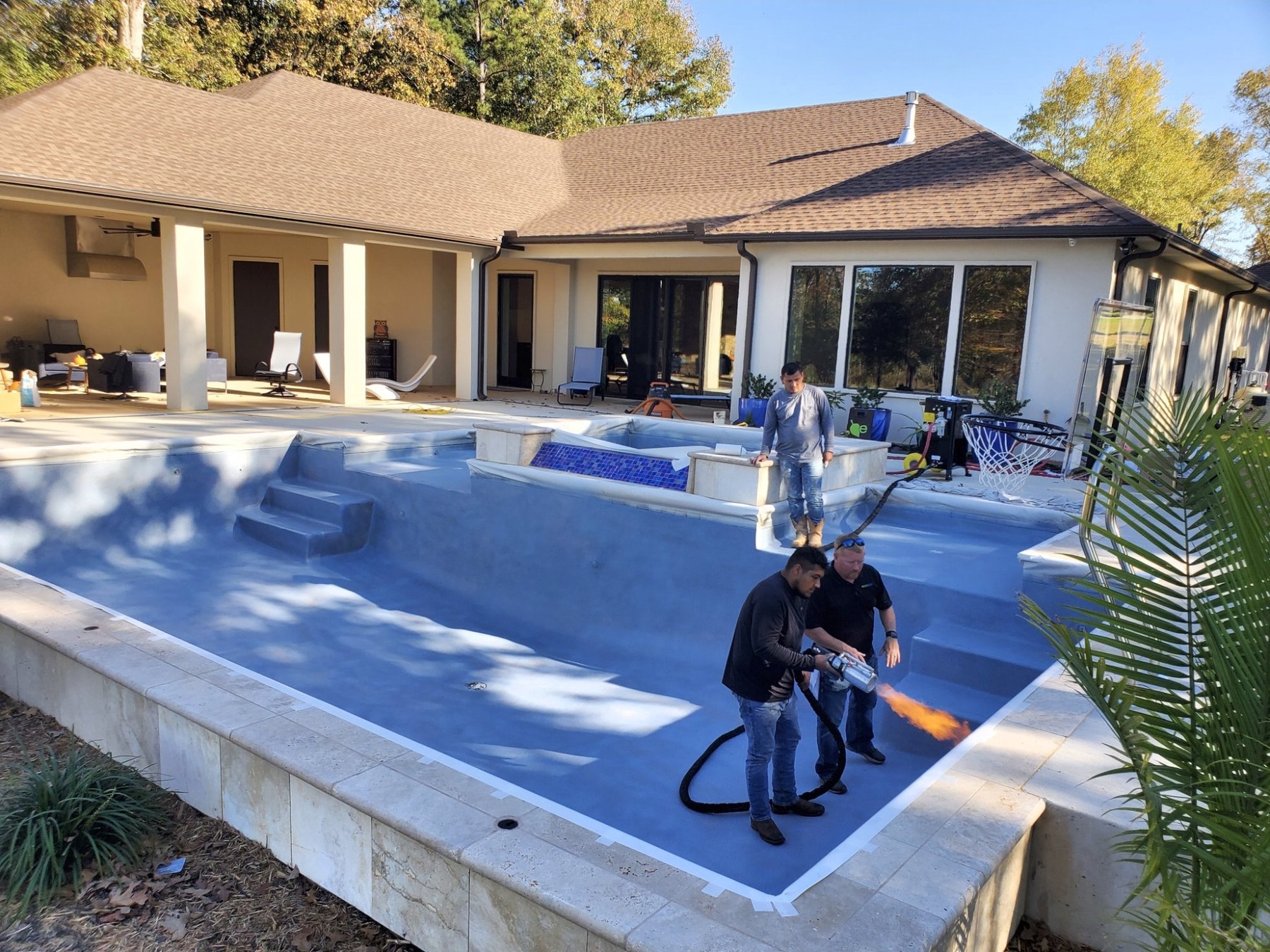
Matt began applying EcoFinish in 2019 after researching the system for about two years. This Liberty City project was his first installation.
9. Localized damage does not automatically mean resurfacing the entire pool
One of Matt’s favorite practical advantages is repairability. Depending on the damage and what is happening underneath it, a localized EcoFinish area can often be repaired and recoated without redoing the entire interior. In Matt’s experience those repairs can blend very well, although no responsible contractor should promise that every patch will be invisible in every color, age and lighting condition.
10. The material carries a 10-year limited residential product warranty
ecoFINISH publishes a 10-year limited residential product warranty for aquaBRIGHT. The published warranty covers qualifying manufactured-material defects and separates those from installation workmanship and substrate problems. The warranty document we reviewed does not state that years of homeowner water-chemistry logs must be submitted as part of its listed claim procedure. Proper maintenance still matters, and failure to maintain the pool properly can affect coverage.
The $5,000 question: what if your old plaster has to come off?
Not every Aqua Pool Finishes resurfacing project needs Hydro-Prep. The comparison below is intentionally limited to a pool where Matt has determined that full Hydro-Prep/removal is required before installing another cementitious finish.
For a hypothetical 100-perimeter-foot pool, Aqua Pool Finishes currently estimates full Hydro-Prep at approximately $5,000: a $1,000 setup charge plus approximately $40 per perimeter foot. The finish prices below are APF’s 2026 planning ranges, not universal Dallas market prices or guaranteed quotes.
| Finish | APF finish midpoint | Hydro-Prep in this scenario | Example initial cost | Matt’s field-life estimate / scenario | Approx. annualized cost |
|---|---|---|---|---|---|
| Marcite plaster | $8,500 | $5,000 | $13,500 | 5–10 years | $1,350–$2,700/yr |
| Quartz | $11,250 | $5,000 | $16,250 | 10–15 years | $1,083–$1,625/yr |
| Mini pebble | $14,000 | $5,000 | $19,000 | 15–20 years | $950–$1,267/yr |
| JewelScapes / glass bead | $17,250 | $5,000 | $22,250 | 15–20 years | $1,113–$1,483/yr |
| Hydrazzo / polished aggregate | $19,000 | $5,000 | $24,000 | 15–20 years | $1,200–$1,600/yr |
| EcoFinish | $16,000 | Potentially no whole-pool Hydro-Prep if the substrate qualifies | $16,000 example | 15–20+ years* | Approx. $800–$1,067/yr* |
*Annualized figures are simple planning illustrations: example project cost divided by the stated service-life estimate/scenario. They do not include financing, inflation, routine pool maintenance, unexpected repairs or future price changes. Actual preparation, price and service life vary by pool, installation, water chemistry, maintenance and site conditions. *For EcoFinish, the 15–20+ year planning range reflects Matt’s field experience—not a manufacturer lifespan promise. Matt has applied EcoFinish since 2019 and has personally inspected EcoFinish pools installed by other contractors as far back as 2008 that still looked good when he saw them. The 10-year manufacturer warranty is a warranty term, not an expiration date.
The table also shows something important: EcoFinish does not magically win every possible comparison. If marcite reaches the high end of Matt’s field estimate and EcoFinish is modeled at only 10 years, basic plaster can have a lower annualized cost. The point is to compare the whole scope and ownership horizon, not to rig the math around one finish.
The catch: EcoFinish is specialized, and the applicator matters
“EcoFinish isn’t something I want somebody learning on my pool. There are a lot of little things you learn from doing it over and over—prep, epoxy timing, temperature, sun and shade, how the material is laying down, and what to do when something doesn’t look right. With high-turnover crews, you can wind up with somebody who has only been doing it a short time training the next guy. They may know the steps, but they haven’t necessarily seen enough problems yet to know how to fix one when it happens.”
Aqua Pool Finishes has been applying EcoFinish since 2019 with an experienced in-house crew. Matt is also open about an early job where bubbles later appeared on a wall. His field diagnosis was that the epoxy on that portion had progressed too far before the coating reached it. The crew changed its sequencing around sun, shade and temperature, and the affected wall was repaired locally rather than automatically resurfacing the entire pool.
That experience is one reason Matt believes the difference between an applicator who knows the basic procedure and an experienced applicator is not that the experienced person will never encounter a problem. It is that experience helps you recognize why something is happening, correct it and avoid repeating it.
Read Matt’s full guide to EcoFinish bubbling, peeling and delamination →
When Matt would tell you not to buy EcoFinish
EcoFinish is Matt’s first recommendation for many long-term DFW homeowners, but it is not the right answer for every customer. If you are selling the house soon and need the lowest-cost clean finish, marcite may make more sense. If you love the natural look of pebble, buy pebble for that reason. If you want the polished look and abalone sparkle available in Hydrazzo, EcoFinish cannot duplicate it. Budget and how long you plan to own the pool matter.
So, can EcoFinish save me from hydroblasting my pool?
Sometimes—but the pool has to qualify. If the existing plaster is sound enough to remain after the bad areas are repaired, EcoFinish can offer a different resurfacing path that may avoid whole-pool Hydro-Prep. If the substrate itself is failing, it still has to be corrected. EcoFinish does not turn bad plaster into good plaster and it is not a structural repair or waterproofing system.
If you have already been told the old finish has to come off before your pool can be replastered, that is the moment I would at least price the EcoFinish option. Compare the preparation each proposal actually includes, the surface you want to live with, the warranty, the installer’s experience and what you expect to spend over the years you plan to own the pool—not just the cheapest number on page one of the bid.
Related Ask Matt guides
Been told your old plaster has to come off?
Send Aqua Pool Finishes photos and tell us what you have been quoted. We can evaluate whether EcoFinish belongs in the comparison and explain what preparation your pool actually needs.
Ask About Your PoolSources & methodology
Pricing and lifespan ranges in this article are Aqua Pool Finishes planning estimates and Matt Phillips’ field observations. Manufacturer statements are identified separately. North Texas water claims are based on North Texas Municipal Water District information; cementitious-finish chemistry and freeze/thaw context are supported by National Plasterers Council technical guidance.