I have worked in pool construction since 2001 and have been personally involved with well over 500 pools. In North Texas, cracks are something I take seriously—but I do not assume every crack has the same cause or means the pool shell is failing.
Pools can crack because of movement in the soil, structural or construction issues, drainage, tree roots, or deterioration limited to the finish itself. North Texas has many clay-rich soils that shrink when dry and swell when wet, so site conditions matter. But a crack in plaster is not automatically a structural crack in the gunite shell. The pattern, movement and whether the pool is losing water all matter.
Why North Texas soil gets so much attention
The USDA Natural Resources Conservation Service explains that Vertisols contain expanding clay minerals and undergo pronounced volume changes with moisture: they shrink as they dry and swell as they become wetter. NRCS also identifies Houston Black—the Texas state soil, often called “black gumbo”—as a clay soil associated with the Blackland Prairie.
That is the mechanism homeowners need to understand. A rigid concrete pool is sitting in ground whose volume can change as moisture changes. The amount and type of movement are site-specific, which is why I would not assume every DFW backyard has identical soil.
I have seen more structural cracking in the clay-heavy Dallas area than in some sandier areas where I have worked. That is my field observation, not a published failure-rate comparison. I also see drainage, roots and the way the shell was originally built play a role.
Not every pool crack is a structural crack
A crack may be limited to plaster or another cementitious finish. It may involve delamination between finish layers. Or it may extend into the concrete shell. Those are not interchangeable diagnoses.
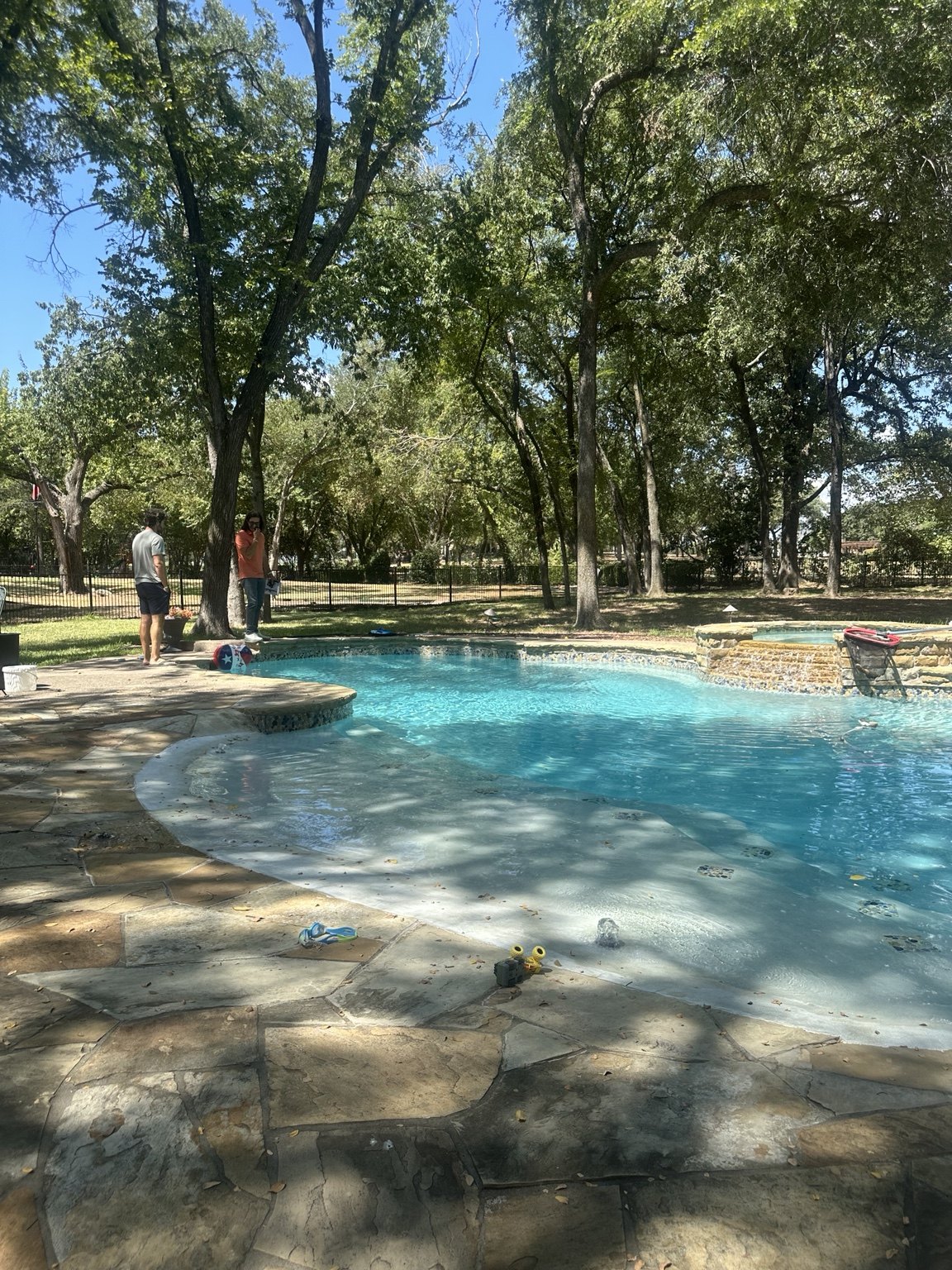
If I see a crack that is changing, a crack associated with water loss, displacement from one side to the other, or related movement at coping, decking or plumbing, I want the underlying cause evaluated before anyone treats resurfacing as the repair.
Construction can matter too
When I investigate cracked pools, I also think about how the shell was constructed: reinforcement, gunite placement and thickness, whether the material was properly applied, and whether the design was appropriate for the site. Soil is important, but “North Texas clay” should not become an excuse that prevents us from looking at the structure itself.
Structural design is project-specific. I do not recommend universal rebar spacing, shell thickness or pier requirements to homeowners online. Those decisions should follow the actual site conditions and appropriate engineering.
What about drainage and tree roots?
Water moving around a property can change soil moisture unevenly. Depending on the site, deck drains, French drains, downspout drainage, grading or other drainage work may be part of managing water around a pool. That does not mean every pool needs every drainage system.
Tree roots can also contribute to movement or damage in some situations. The point is to diagnose the site rather than choosing a repair based only on what the crack looks like from above the water.
Can resurfacing fix a cracked pool?
Resurfacing can repair a damaged finish, but it is not a substitute for structural repair. If the crack is only in an old finish, the resurfacing process may address it as part of substrate preparation. If the shell itself is moving or cracked, the structural problem needs to be addressed first.
Should you drain the pool to inspect a crack?
Do not assume draining is harmless. Groundwater can create hydrostatic pressure against an empty shell, particularly after heavy rain or in saturated conditions. Professional draining procedures account for that risk.
During Hurricane Harvey, my company was involved in demolishing and rebuilding a Houston-area commercial pool that had been partially drained before the storm and then floated as the ground became saturated. That was an extreme event, but it is why I take hydrostatic pressure seriously.
A North Texas crack deserves diagnosis, not panic. First determine whether the problem is in the finish, the shell, the surrounding soil/drainage, or more than one part of the pool system. Then choose the repair.
Related Ask Matt guides
Sources & how this article was built
Matt’s observations are labeled as field experience. Soil behavior is supported by USDA Natural Resources Conservation Service information on Vertisols and Texas soils. Site-specific structural recommendations should come from appropriate inspection and engineering rather than this general article.
Have a crack you are concerned about?
Aqua Pool Finishes can evaluate the finish and help determine whether resurfacing belongs in the repair plan.
Ask About Your Pool